
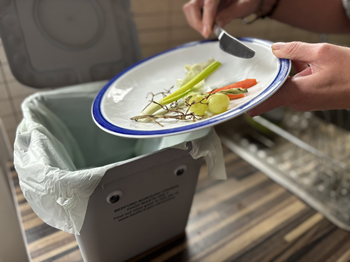
Bedford Borough Council is thanking residents for helping make the borough’s weekly food waste collection a success, with more than 2,790 tonnes of food waste diverted from black bins in the first six months. That is the equivalent of around 550 African elephants!
It has been taken to Biogen’s anaerobic digestion facility, where it is turned into renewable energy for the National Grid and nutrient-rich liquid fertiliser for local farms. Sending food waste to Biogen is a cheaper alternative to disposing of it with other non-recyclable waste. Keeping food out of black bins helps reduce the overall cost of waste disposal, while creating useful energy and fertiliser. The council has seen a reduction of over 3,000 tonnes of waste collected in black bins since April, compared to the same time period last year.
Since the service launched on Monday 30 March 2026, thousands of households have made food waste recycling part of their weekly routine. The Council is encouraging anyone who has not yet started, or paused their use of the service over the summer, to give it another go.
Councillor Nicky Gribble, Portfolio Holder for Environment, said, “Thank you to every resident who has used their food waste caddy over the past six months. Together, you have diverted more than 2,790 tonnes from black bins, helped reduce disposal costs, and turned leftovers into renewable energy and fertiliser for local farms.
“If you have not used your caddy recently, why not start again this week? It only takes a moment, and every caddy counts.”
Food waste that can go in the outdoor food waste bin includes fruit and vegetables, meat, fish and bones, dairy products, eggs and eggshells, bread, pasta, rice and cereals, tea bags, coffee grounds and filters, and plate scrapings and leftovers. Where possible, residents who can compost at home are encouraged to compost suitable food waste.
Residents can keep a kitchen caddy handy while cooking or clearing plates, then empty it into their outdoor food waste bin. Many people find using a caddy liner makes this quicker, cleaner and easier. The outdoor food waste bin should be put out every collection day, alongside the orange-lidded or black bin, even if it is only partly full. Food waste is collected by a separate vehicle, so it may be emptied at a different time than other bins.
Weekly collections also cover flats. Most flats have a silver-lidded communal food waste wheelie bin or a nearby green collection point. Any flat resident who has not received a kitchen caddy should report it as a missing bin. If a food waste bin or caddy is missing or damaged, residents can request a replacement online at www.bedford.gov.uk/RequestBins
Reducing food waste remains the best first step. Planning meals, using leftovers and checking date labels can save money as well as waste. For the food waste that cannot be avoided, the caddy is the best place for it. Find advice to reduce food waste at www.LoveFoodHateWaste.com
For more information, visit www.bedford.gov.uk/FoodWaste